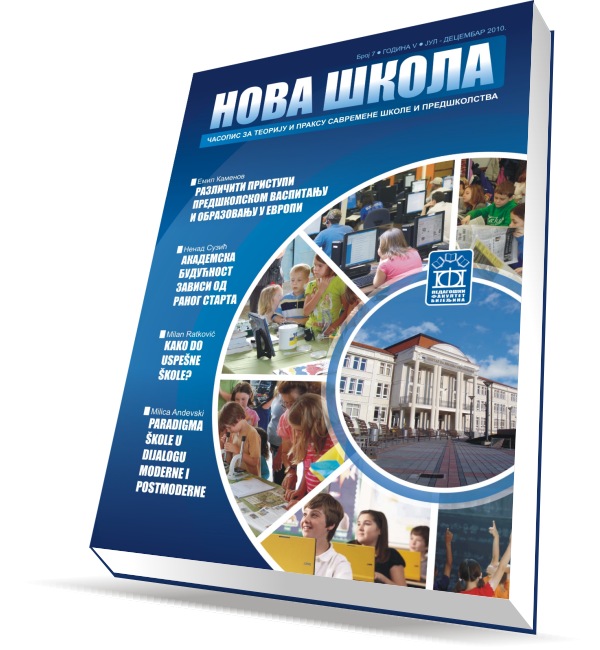
HOW TO ACHIEVE A SUCCESSFUL SCHOOL?
Keywords:
successful school, school crisis, the quality of educationAbstract
For citizens of Serbia, in long term, there is no more important interest than a successful school. What is its quality, where is its place on the European educational space of the domestic and foreign markets of knowledge and skills, and how its graduated pupils rank in further education and employment that is the main national question.
Contemporary school is located on the crossroad of the two epochs: finished epoch of the second millennium and its old fashioned traditional school which resists and refuses to leave, and at the beginning of the third millennium a clear vision and concept of a successful school has been activated that hardly infiltrates, refuses to withdraw, maintains on the road to the successful school. Where is our school now, what must be and can be changed in our conditions, what new to introduce, how to overlook changes, how to correct and direct them toward processes of its qualitative transformation?
There are two problems: first relates to the fact that during last twenty years the official educational policies have lacked strength, often knowledge to reality, and meet them, if needed confront; the second problem is that a huge army of teachers and professors failed to establish their uncompromising attitudes toward phenomena of school crisis. They honestly notice it, but they relate to it leniently considering it temporary. Greater uncertainty for the future of our schools lies in relations to accelerated technological development, huge social transformations and evident backwardness in relation to modernisation of European schools.
These are axiomatic reasons for discussion about school crisis, its unsatisfactory social and pedagogic ambient, and possible exit from that unfavourable state and necessary entry in well thought through and deep transformations. The objective is to answer the question: first, why the quality has been jeopardised, second how to achieve a successful school in our conditions?
Downloads
References
1. Amonošvili, Š. A. (1997). Škola života. Beograd: Učiteljski fakultet.
2. Bloom, B. S. (1970). Taksonomija ili klasifikacija obrazovnih i odgojnih ciljeva, Beograd:
Jugoslovenski zavod za proučavanje školskih i prosvetnih pitanja.
3. Dietmar, L. (1993). Bildungssysteme in Europe. Bonn: Europa Union-Verlag.
4. Hargreaves, D. H., Hopkins, D. (2003). Škola može više – menadžment i praksa razvojnog
planiranja.Ljubljana: Zavod za školstvo.
5. Ratković, M. (2010). Put ka uspešnoj školi. Beograd – Novi Sad: Srpska akademija obrazovanja –
Prometej.
6. Vud, Dž. (1997). Efikasne škole. Beograd: Učiteljski fakultet.
7. OECD: New Technologies in the 1990s, Paris, 1990.
8. EUROPEAN COMMISSION Directorate – General for Education and Culture IMPLEMENTATION
OF „EDUCATION AND TRAINING 2010" WORK PROGRAMME.